AI in practice — Dan Stine, AIA
08 · AI in practice

AI in practice, taught while it is still changing

His pattern has been to adopt a new technology in practice, work out what it is good for, then teach it before textbooks exist. He did this with CAD, BIM, lighting simulation, energy modeling, and VR. He is doing it now with AI, on a national task force, at Lake Flato, and in a graduate seminar.

72Staff in the use-case workshops
~230Ideas, four pilot tracks
16Tools on the Toolshed
99%AIA delegate vote for the AI resolution

How it unfolded

Practice → Profession → Education

Stine adopts a technology in practice, works out what it is good for, then teaches it before the textbooks exist. He did this with CAD, BIM, lighting simulation, early-stage energy modeling, and virtual reality. He is doing it now with artificial intelligence at the AIA, at a 160-person firm, and in a graduate seminar.
May 2024
Policy first. Drafted Lake Flato's one-page AI usage policy: approved tools, firm credentials only, confidentiality by contract. Adopted in November with a training video and signed acknowledgment; a notetaking policy followed in January 2025.
2025
Groundwork. Pilots and vendor evaluations, FlakeNet AI search grounded in the firm's own content, and a consultant-led implementation plan. Led the selection of the firm's Data & AI consultant and a four-month Data & AI Accelerator as Lake Flato's Data & AI Leader.
Jan 2026
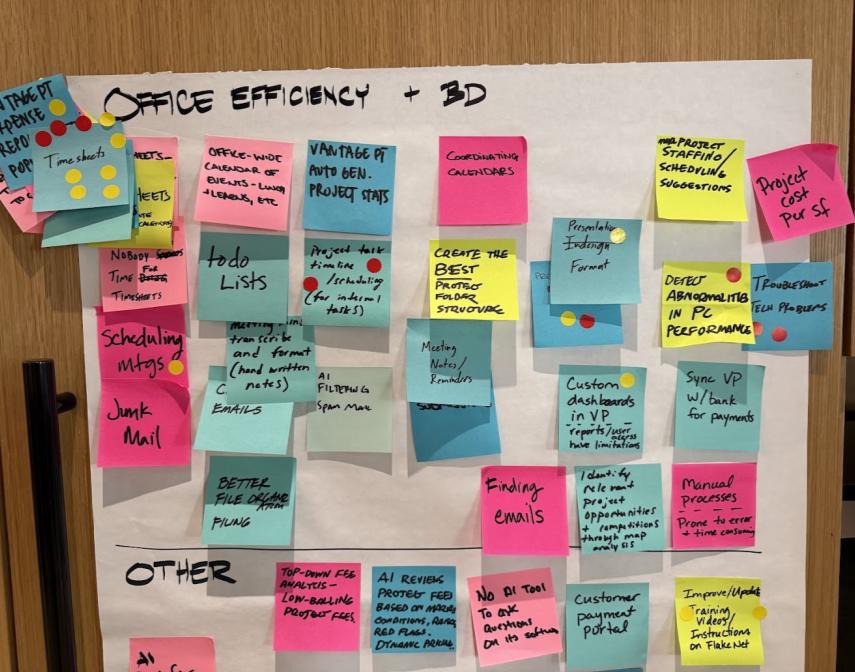
Use cases from the floor. Four workshops, 72 staff, roughly 230 ideas, four pilot tracks. Most votes went to timesheets, meeting notes, specifications, and documentation QA/QC. Renderings ranked low.
Jul 2026
Platform. Five assistants scored against firm workflows; an enterprise seat on every desk, both founding partners included. A weekly AI lunch-and-learn, a weekly leadership stand-up, a monthly all-hands segment, and a Data + AI team with named roles.
Aug 2026
Build small, share, iterate. The Toolshed: sixteen internal tools and counting, each wearing a lifecycle badge from Starter to Beta to Active, with bylines for the staff who built them. Fee planner, project schedules, field reports, a pursuit tracker, design-performance dashboards, a fire-assembly finder.
A workshop wall of categorized AI use cases produced with Lake Flato staff
The use-case wall from the January 2026 workshops, later taught as a graduate case study.
99%
AIA delegate vote for the 2025 member-wide AI policy resolution the task force now carries out
100K+
Members reached by the AIA AI Firm Toolkit he co-authored
4
Moves any firm can copy: select use cases, verify outputs, build policy, integrate in phases
Next · Texas Society of Architects, San Antonio · October 16, 2026
AI in Architecture: From Education to Practice
Two years of Lake Flato's program, the AIA task force's shipped work, and eight weeks of a live graduate seminar, closing with a 30/60/90-day plan for a ten-person firm. Ends with one line: suggested, not posted.

What the policy says

One page · May 2024, updated July 2026
01
Approved tools only
Use firm-licensed, firm-provided, or firm-built tools listed in the appendix on the intranet.
02
Firm credentials only
Personal accounts for project work are prohibited.
03
Meetings
Do not join an external meeting recorded by an AI tool; offer the firm's own meeting assistant and review the summary before sending.
04
Confidentiality
Outputs must not disclose client-confidential information. Check the contract and the project directory.
05
Disclosure
Disclosure of AI use is not required unless the contract requires it.

The 2026 update added the enterprise assistant for everyone, approved connectors and MCP servers only, a caution that web search sends fragments to third parties, no thumbs-up or thumbs-down feedback on client work, and a single owner for settings. The approved-tools appendix is paired with a mandatory training video and signed acknowledgment; a notetaking policy followed in January 2025.

Written in May 2024, adopted in November. The policy came before the pilots, so experiments ran inside limits the founding partners had already agreed to.

The Data + AI team

Structure set in May 2026
Executive sponsor
Chief Operating Officer
Owns the budget and the results.
Data & AI Lead
Technology strategy
Governance and lakehouse architecture. The role Stine held through the Accelerator and platform decision.
Agentic AI Workflow Architect
Processes to specs
Turns business processes into build-ready specifications with a human in the loop.
Change & Strategy Lead
Adoption
Firm-wide training, the super-user network, and value tracking.
Design Technology · DT ambassador
The studio voice
Reports problems from the studios and keeps designers involved in tool decisions.
The rhythm: a weekly AI lunch-and-learn, a weekly leadership stand-up run on the assistant's own summaries and action items, a monthly AI segment at the all-hands, one AI landing page on the intranet, and the Toolshed as the single front door. Every session is recorded and posted on the intranet.

The AIA AI Firm Toolkit

AIA Artificial Intelligence Task Force · April 2026

In 2025 AIA delegates voted 99 percent in favor of a member-wide resolution on artificial intelligence. The task force Stine serves on turned it into guidance for firms, published in April 2026 and distributed to more than 100,000 members.

Diagnostic
AI maturity assessment
Where a firm stands today, from experimenting to integrated.
Literacy
AI literacy for architects
What the tools do, what they cannot, and how to verify.
Frameworks
Seven policy and ethics frameworks
Confidentiality, disclosure, liability, intellectual property, data, bias, and professional judgment.
Change
Change management
Adoption for firms of every size.

Four moves

For a small firm
01
Select use cases from the floor
Ask the people doing the work. At Lake Flato the votes went to timesheets, meeting notes, specifications, and documentation QA/QC, with renderings near the bottom.
02
Verify outputs, every time
A verification log is required of graduate students and staff alike: tools, purpose, what changed by hand, what was checked, and disclosure.
03
Build the policy first
One page, adopted before the pilots, with a signed acknowledgment and a training video.
04
Integrate in phases
Policy, groundwork, use cases, platform, tools: a 30/60/90-day plan a small firm can set up in an afternoon.

The graduate seminar

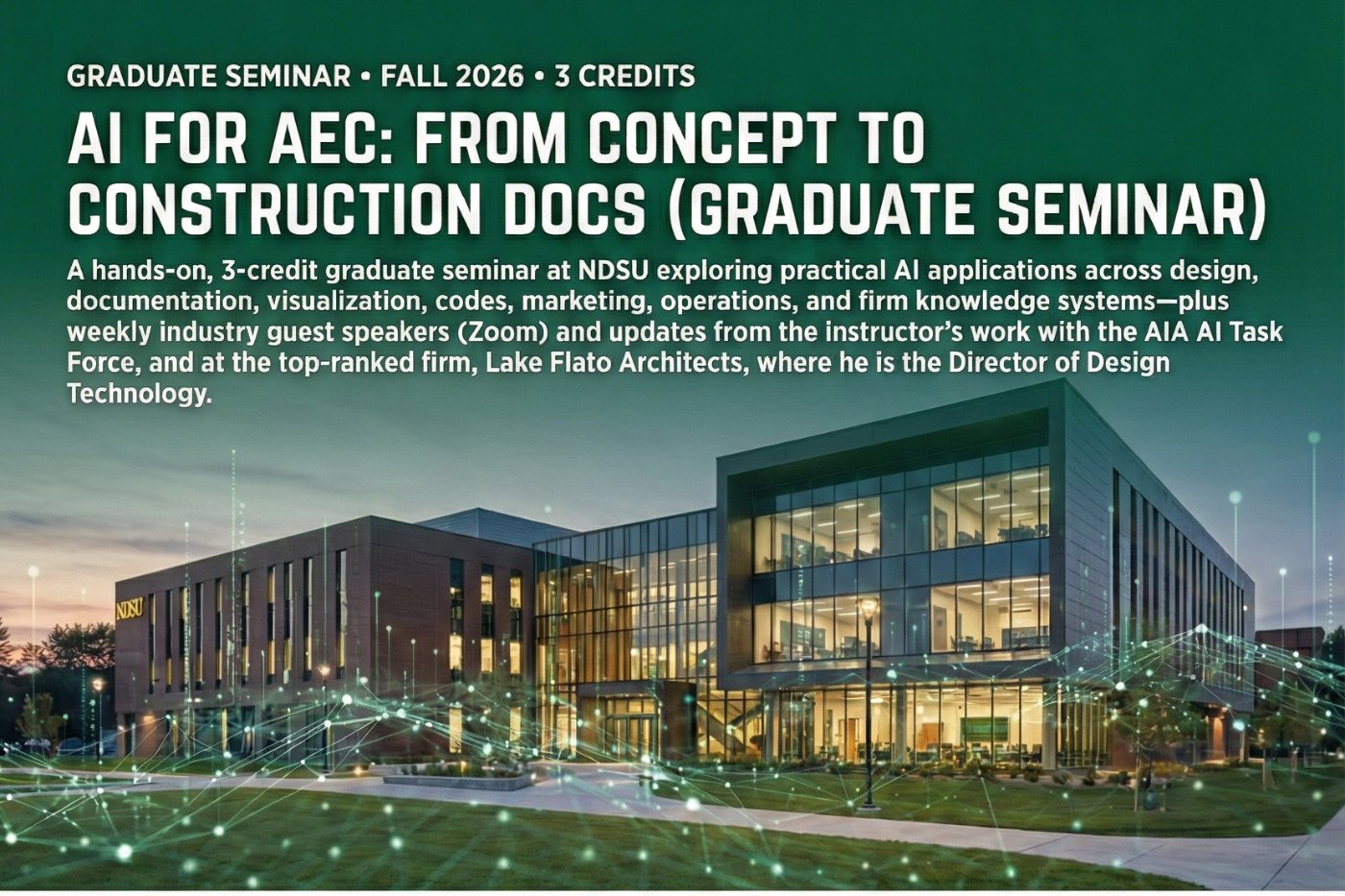
NDSU ARCH 789 · Fall 2026 · 3 credits

AI for AEC: From Concept to Construction Docs is a hands-on graduate seminar at North Dakota State University, taught while the subject is still changing. Mondays are an instructor lecture and demo in Renaissance Hall; Thursdays bring an industry guest by Zoom. The course is BIM-centered, anchored in Revit and Autodesk Forma, and covers design, visualization, documentation, building codes, marketing, operations, data strategy, risk, and sustainability across sixteen weeks.

There is no textbook. Students carry a Claude Pro seat instead, and every free reading is posted: the RIBA AI Report 2026, the AIA AI Firm Toolkit, the Chaos white paper on AI in architecture, and Databricks on the data lakehouse. Every hands-on submission includes an AI Use and Verification Log recording the tools used, what was changed by hand, what was checked, and disclosure. Students are graded on judgment in applying, verifying, and assessing AI workflows, not on whether a tool produced a polished artifact.
11
Confirmed industry guests, with more invited
16
Weeks, two sessions each
6
Hands-on exercises, each with a verification log
$0
Textbook cost; a Claude Pro seat instead
The course arc
Part 1 · Weeks 1–3
Foundations
AI literacy, how LLMs work, prompting, privacy and enterprise settings, the AIA AI Firm Toolkit, and the verification habits that govern the whole course.
Part 2 · Weeks 4–9
Design and delivery tools
Site analysis in Forma, visualization, AI in Revit, building codes, and drawing and specification QA/QC, in the order a project moves.
Part 3 · Weeks 10–11
Operations and toolmaking
Marketing, finance, HR, knowledge management, and meeting AI; then students flip from users to toolmakers and the final project launches.
Part 4 · Weeks 12–13
Data and the firm
The lakehouse as the firm's central brain, governance, the Lake Flato accelerator case study, enterprise LLM strategy, and firm policy.
Part 5 · Weeks 14–16
Risk, sustainability, futures
Contracts, liability, copyright, and the EU AI Act; the environmental cost of AI; new roles, agentic AI, and desk crits.
Literacy and ethics first, because students cannot verify what they do not understand; then tools in the order of a project's life; then the firm as a system; then consequences and careers. Every exercise has a free pathway, and the two heaviest ideas, verification and data governance, are seeded early and return twice.
Guest speakers · Thursdays by Zoom
Wk 1
Aaron Vorwerk
AEC practice leader, formerly Autodesk · AIA AI Task Force
The state of AI in AEC: what is real right now
Wk 2
Ryan Bergman
John Deere
How LLMs actually work, and how John Deere uses AI in the field. Gave the LLM keynote at the AIA26 AI symposium Stine helped curate.
Wk 5
Gavin Argo
Olson Kundig · custom visualization tool team
AI visualization in practice: building your own tools vs. buying them
Wk 6
Ross Wagner
Pirros
AI-powered Revit tools and drawing automation
Wk 7
Sharare Norouzi
Little Diversified Architectural Consulting
BIM automation and computational design
Wk 8
Scott Reynolds
Co-founder and CEO, UpCodes
AI for code research and QA/QC
Wk 10
Amber Lombardo
AEC marketing and operations
AI in AEC marketing and firm operations
Wk 11
Md Shariful Alam
Mithun
Developing AI tools inside a design firm
Wk 15
Santino Medina
Google · data-center projects
Designing the buildings AI lives in: what hyperscale compute asks of architects, land, power, and water
Wk 15
Reese Meadows
University of Washington graduate student · former Lake Flato Design Performance intern
The Lake Flato SEEDS project: how a design-performance data tool was built and what it does
Wk 16
Eric Cesal
Architect and author, Down Detour Road (MIT Press) · AIA AI Task Force
The future of the profession, followed by final-project desk crits
Sixteen weeks
1AI literacy for architects; the AEC adoption curve
2How LLMs work; prompting as brief-writing; privacy settings
3Responsible AI: the AIA AI Firm Toolkit, verification habits, the tells of AI writing
4Early design in Autodesk Forma: rapid wind and noise analysis
5AI visualization: image models, Enscape and DLSS, Veras, labeling rules
6AI in Revit I: Autodesk Assistant, Pirros, SWAPP
7AI in Revit II: connecting an LLM to the model (MCP), Dynamo
8Building codes with UpCodes: citations and traceability
9Drawing and specification QA/QC; human-in-the-loop checkpoints
10Firm operations: marketing, ERP, intranet search, meeting AI and PII
11Building your own tools with Claude; standalone HTML tools
12Data strategy: the lakehouse as the firm's central brain
13The AI-ready firm: enterprise rollout, policy, use-case discovery
14Risk and professional practice: contracts, liability, copyright, EU AI Act
15Sustainability: data centers, energy, water; design-performance data
16New roles and the future of practice; desk crits
How the work is graded
30%Six hands-on exercises: interview an LLM and document a hallucination; a Forma site study; AI-assisted visualization with a critique of what the model invented; drawing automation in Revit with time saved and errors caught; a code-research memo verified against the adopted code text; a presentation rebuilt as a standalone HTML file.
25%Final project: a working AI-assisted tool or automation built around a real workflow, with a verification log and a governance note, presented live in the final exam slot.
20%Participation, including prepared questions posted for each guest the night before.
15%Data strategy essay: the lakehouse as a firm's central brain, and owning your data versus depending on vendors.
10%Four guest-speaker insight briefs connecting a speaker's practice to course concepts.
Course poster for AI for AEC: From Concept to Construction Docs, NDSU graduate seminar, Fall 2026
Course poster, North Dakota State University.